Timothy Slack Auger Bits
Timothy K. Slack
Timothy K. Slack, Sr. (1809–1879) was one of roughly 100 men practicing the augermaker's trade in the Elk Creek watershed on the southeastern Pennsylvania–Maryland border during the first third of the 19th century. These craftsmen plied their trade in some fifteen small, rural workshops.(1) Often located on farmsteads, these modest operations were typically staffed by anywhere from three to six hands. Because the trade required skills more specialized than general blacksmithing, workers often began their careers as apprentices. Timothy Slack apprenticed with the Garrett family of Strickersville in New London Township, Chester County, Pennsylvania. He learned the trade under Thomas Garrett (1772—1832), a farmer and pioneering augermaker, and his son, Evan (1798—1878).(2) If Slack began his apprenticeship at the traditional age of fourteen, he would have completed his training in 1830.
A 1925 newspaper account, written nearly ninety years after the events it describes, states that Timothy Slack, Sr., began his career near Wilmington, Delaware, as part of an enterprise known as Caswell & Slack.(3) By 1835, Slack was practicing his trade in New London Township. The 1840 federal census shows he was married, with a one-year-old son, and living in East Nottingham Township. The census records three males between the ages of 20 and 30 living in the household, suggesting he may have been providing housing for apprentices or employees. He is known to have introduced his younger brother Thomas (1817–1897) to the art of augermaking. Though Thomas Slack never produced anywhere near as many augers as his older brother Timothy, he carried on the trade in New London Township for some thirty-five years,(4) stamping his output THOs. SLACK.
Timothy Slack's business prospered. By 1848, the Philadelphia hardware house R. Paxon & Son had placed an advertisement in a local newspaper showcasing 5,000 quarters of Slack's augers.(5) Anthropologist James Price explained the "quarter" system in a Facebook post.
A “quarter” was essentially the auger trade’s unit of size and value, not a unit of weight. An 8/4 Timothy Slack auger contained eight quarter-inch size units because it was two inches in diameter. Manufacturers and wholesalers could total those quarter units across an assorted shipment and charge so much per quarter. The practice automatically made larger augers more expensive and roughly compensated for their greater material and manufacturing cost. Thus an advertisement for “5,000 quarters” describes a quantity of augers expressed in aggregate size units, rather than 5,000 pounds or 5,000 individual tools.(6)
The 1850 Census of Manufactures for Chester County lists Timothy Slack, Sr., as the owner of one of three augermaking shops in East Nottingham Township. None of the businesses used water power or steam. Timothy Slack employed four hands, Robert K. Collum employed three, and John Collum employed two. Slack paid his workers the best wages—an average of twenty dollars per hand per month, as opposed to Robert K. and John Collum's average of sixteen. Despite the lack of water power, the Slack shop produced an impressive 24,000 quarters of augers in just twelve months. Early Timothy Slack augers are stamped TMy SLACK.
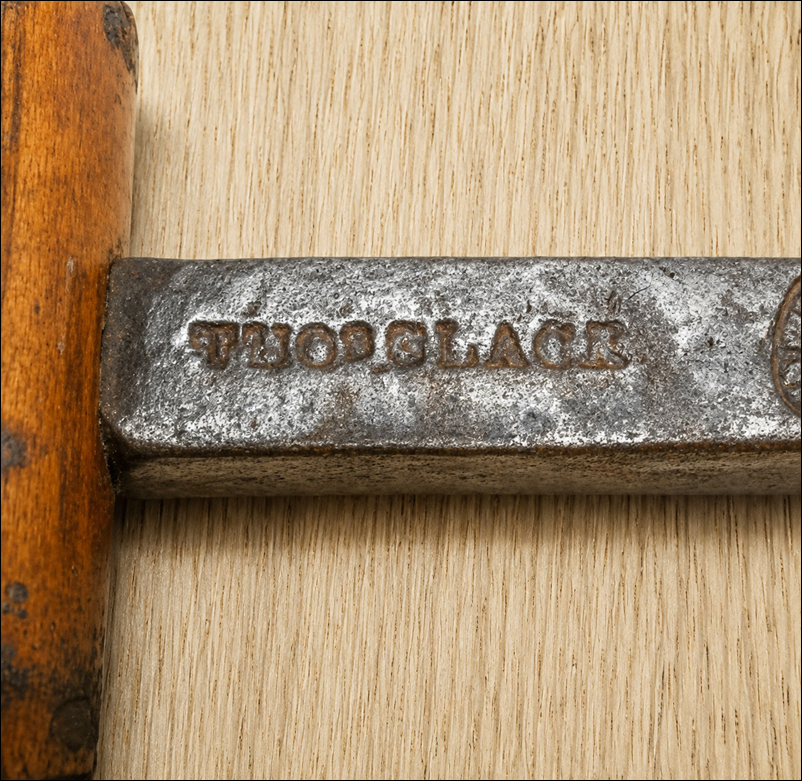
early THOs SLACK T-auger stamp
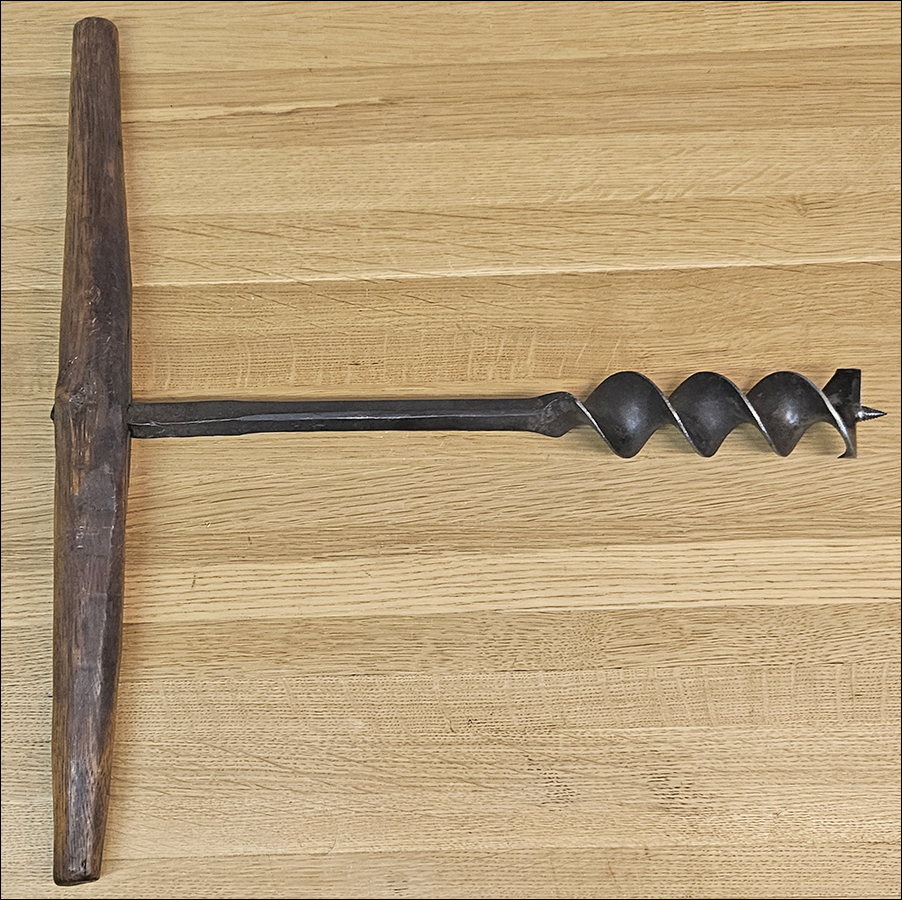
early Timothy Slack T-auger
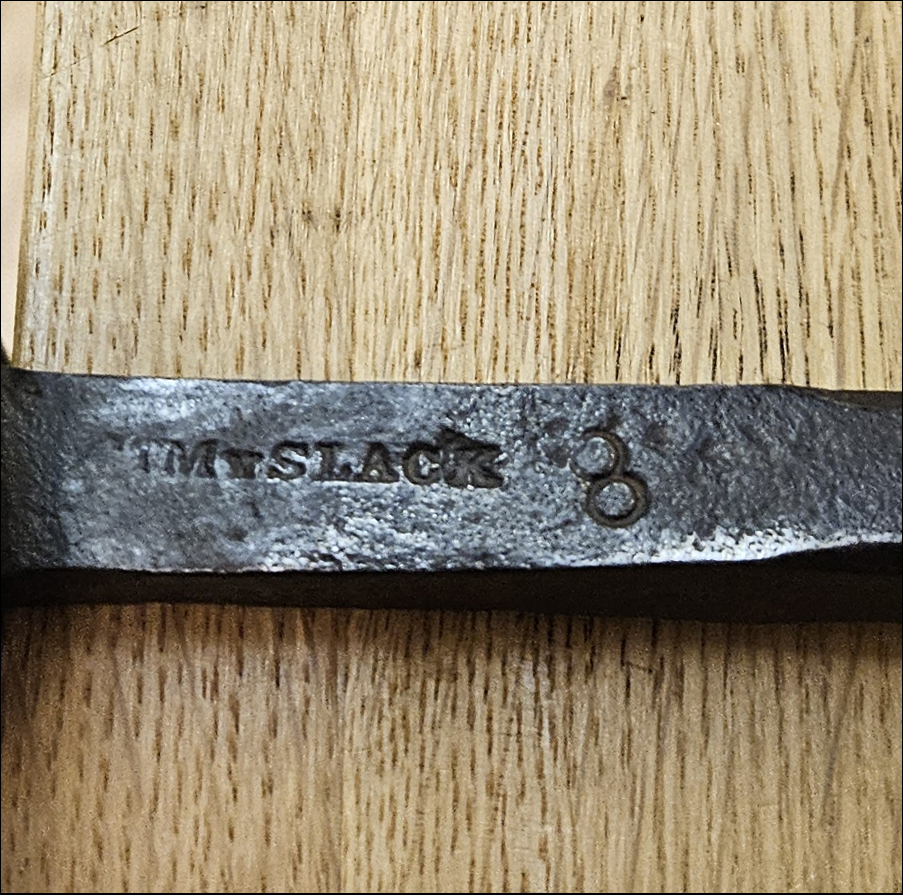
By 1860, Timothy Slack, Sr., had become more of a farmer than an augermaker. Though he continued to operate his auger business from a workshop on his farm(7), agriculture had become his primary source of income. The federal census of agriculture for 1870 indicates he farmed 165 acres, growing wheat, corn, oats, and hay while keeping a horse, five mules, a pair of oxen, five milk cows, five pigs, and a small herd of beef cattle. Slack built a twelve-room, cottage-style brick mansion on his property and surrounded it with fruit and ornamental trees. He also built two tenement houses, most likely for his workers, a two-story barn, and a tool house, all with slate roofs. His brick, slate-roofed workshop housed two forges.(8) At the time of his death in September 1879, his augers had earned a reputation equal to those of any of the area's manufacturers and those of the much larger Philadelphia works of Job T. Pugh.
Timothy Slack, jr.
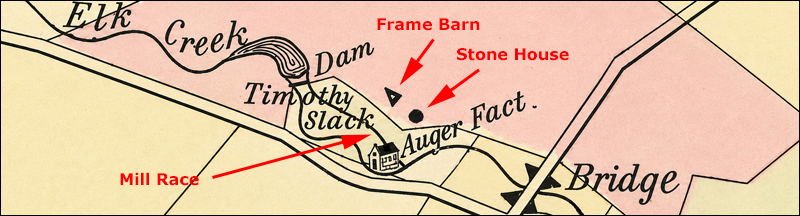
In January 1880, just four months after his father's death, Timothy Slack, Jr. (1847–1910) bought four acres on the West Branch of Big Elk Creek from William F. McHenry. The purchase included waterpower rights, a dam, and a burned-out paper mill. The younger Slack was not one to let grass grow under his feet; by March he was making augers in a new, one-story stone factory on the site—complete with a tilt hammer and using powerful fans rather than bellows. A nine-horsepower overshot waterwheel powered the operation; by fall the business employed eight workers. Slack marketed his augers aggressively. In 1885, a local newspaper noted:
Mr. Slack ships most of his augers to Baltimore and Philadelphia and from these cities they find their way into all parts of this country and distant lands. An expert hand can twist fifty inch [i.e., one-inch] augers a day and a filer can file twenty. The wholesale price of augers is seven and a half cents per quarter inch.(9)
The Elk Creek businesses built their reputation on the quality of their traditional augers rather than on bits designed for use in a brace. Some, if not most, never went on to produce auger bits, a precision product more difficult to manufacture. The Slack operation jumped into the bit business with both feet. Although the first mention of a Slack auger bit in a local newspaper occurred in 1889, it is likely that production had begun at least a decade earlier.
The Slacks manufactured double-spur auger bits and left the insides of the spirals unpolished, a finish sometimes referred to as "black twist." Other Pennsylvania manufacturers using the technique included DeWiitt, Morrison & Kelley, producers of Arrow Brand bits and Job T. Pugh. While the operation's traditional augers continued to be marked with the business's name on the shaft, its auger bits were stamped on the tang. Early Timothy Slack bits bore the designation TIM'Y SLACK. Later, both bits and augers carried a simple T. SLACK stamp.

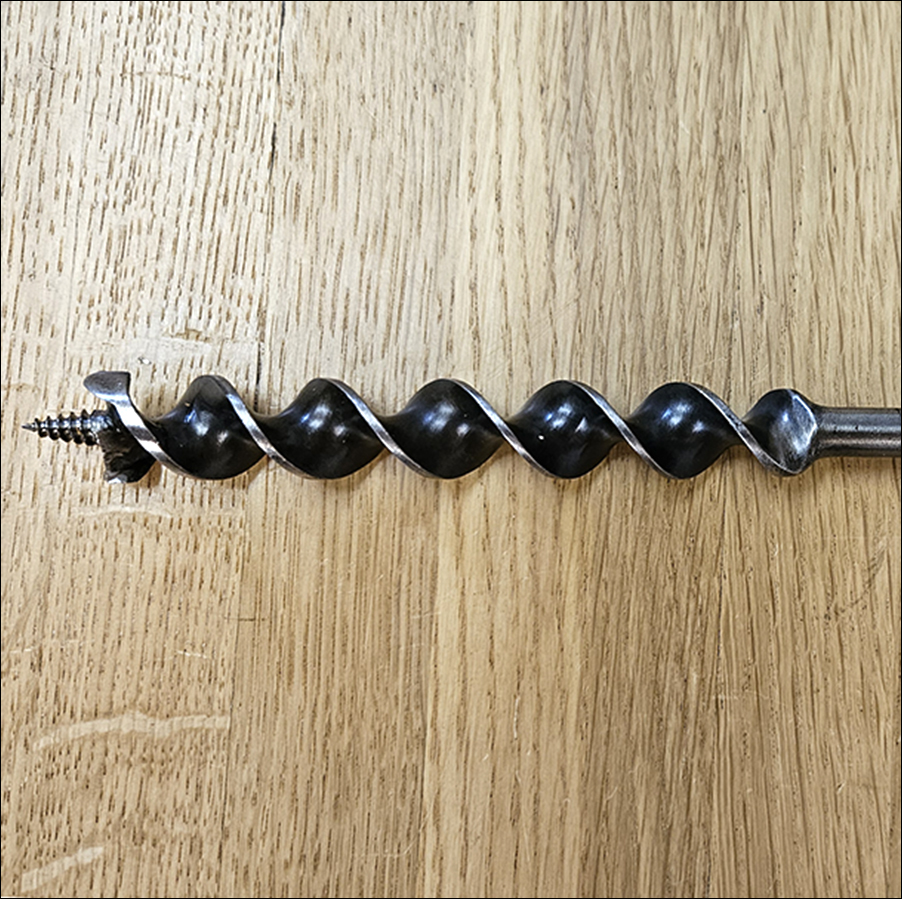
black twist auger
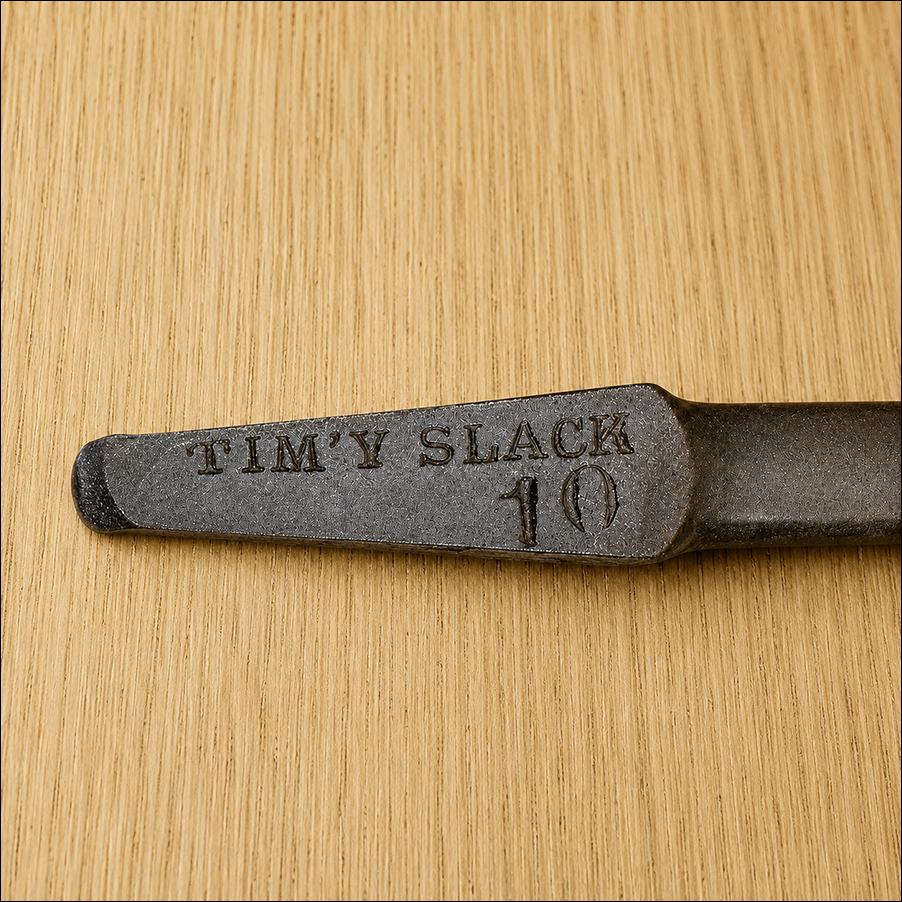
early TIM'Y Slack bit stamp
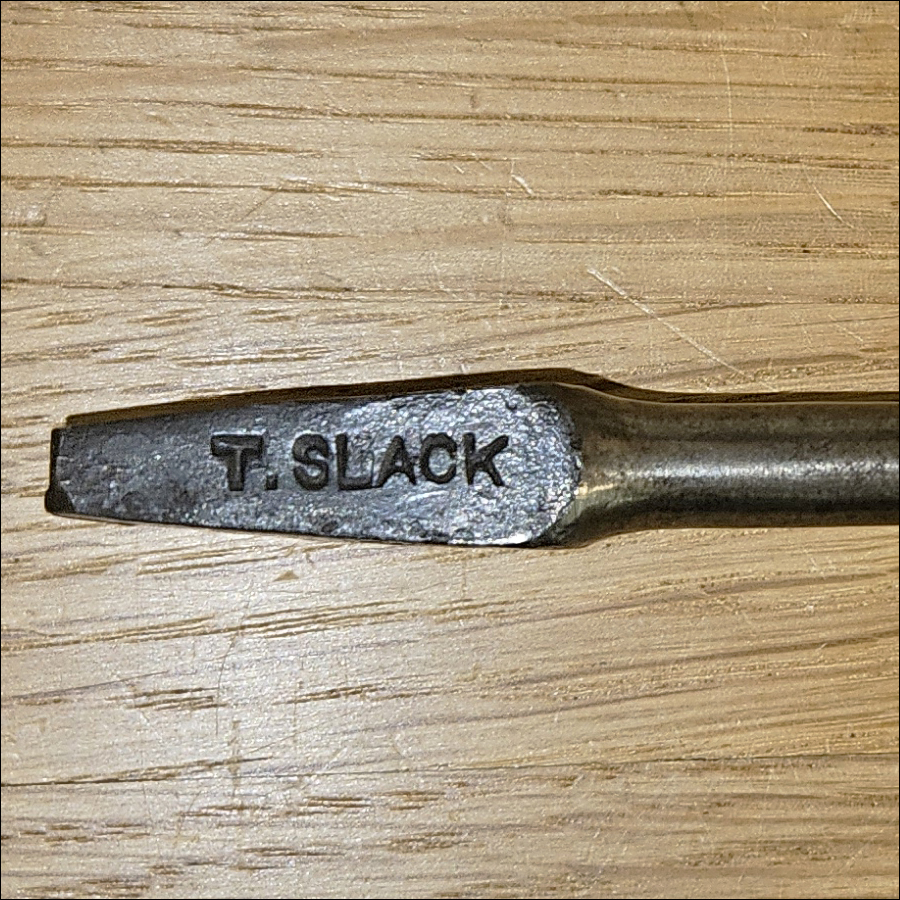
later T. Slack bit stamp
Timothy Slack Jr. continued to make improvements to the factory, adding a second tilt hammer in 1882 and a roof and skylights in 1895. Disaster struck when a powerful winter ice flood washed away the factory's dam in the winter of 1904.(10) Two weeks later, the operation reopened using steam power, a common—if temporary—solution in an era when many businesses depended on water power. Work on a replacement dam was completed in early fall. A photograph from that year shows that the factory itself was not the structure it had been a three decades earlier. A windowless cupola, patched chimneys, an improvised cover over missing skylights, distressed masonry, and neglected additions all point to deferred maintenance.
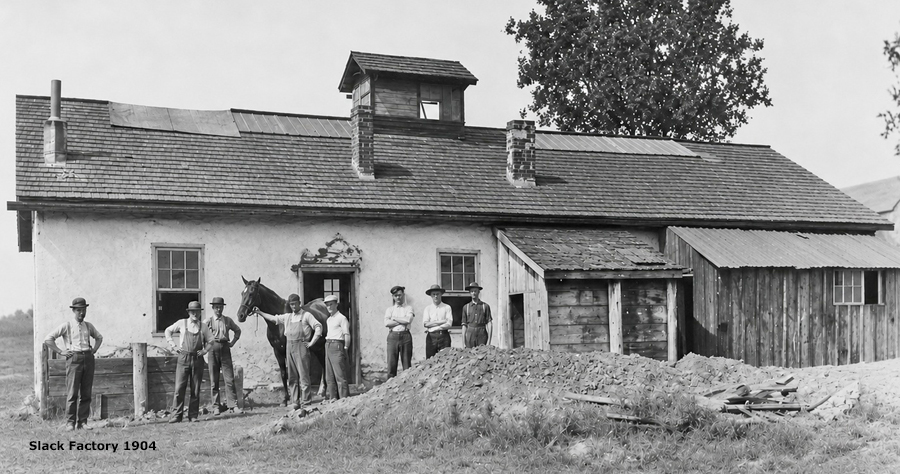
On September 27, 1906, The Oxford Press reported that Timothy Slack, Jr., had purchased the site of a tobacco warehouse from S. R. Dickey & Company and planned to move his auger business from East Nottingham Township to the borough of Oxford. Although the site offered no opportunity for water power, its Chase Street location was a few hundred feet from a Philadelphia, Baltimore & Washington Railroad spur. Slack cited the difficulty of finding workers willing to leave town to work in the country as his reason for relocating. While that may be true, he himself had moved to Oxford in 1902, and the proximity of the site to his new home, the convenience of shipping raw materials and finished product, and the dilapidated condition of his rural factory also factored into his decision. The lack of water power presented no insurmountable problems—Slack intended to use a large gas engine to power the operation.
Shortly before the move, Samuel M. Slack, Timothy Jr.'s thirty-four-year-old son, left a position as engineer and electrician at the Chester County Home and joined the business, which then became Timothy Slack & Son. Though the enterprise had a new name, it continued to stamp its products T. SLACK. Its new brick factory measured 26 by 72 feet. In addition to the principals, the works employed some eight hands.
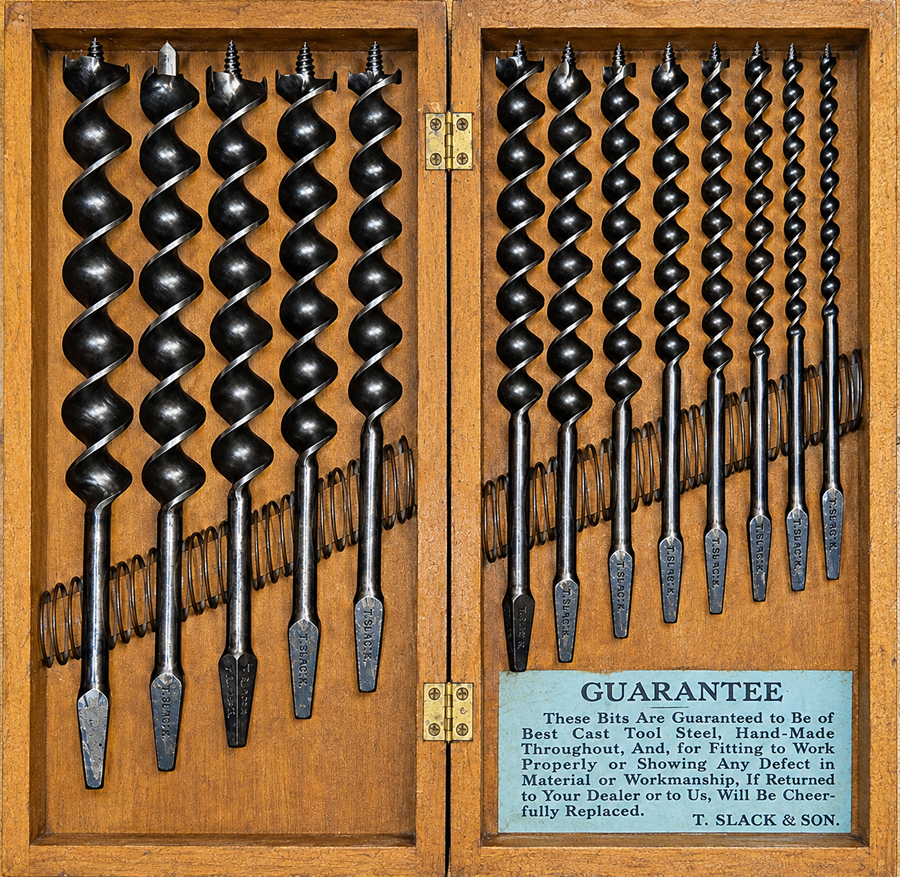
Timothy Slack & Son set
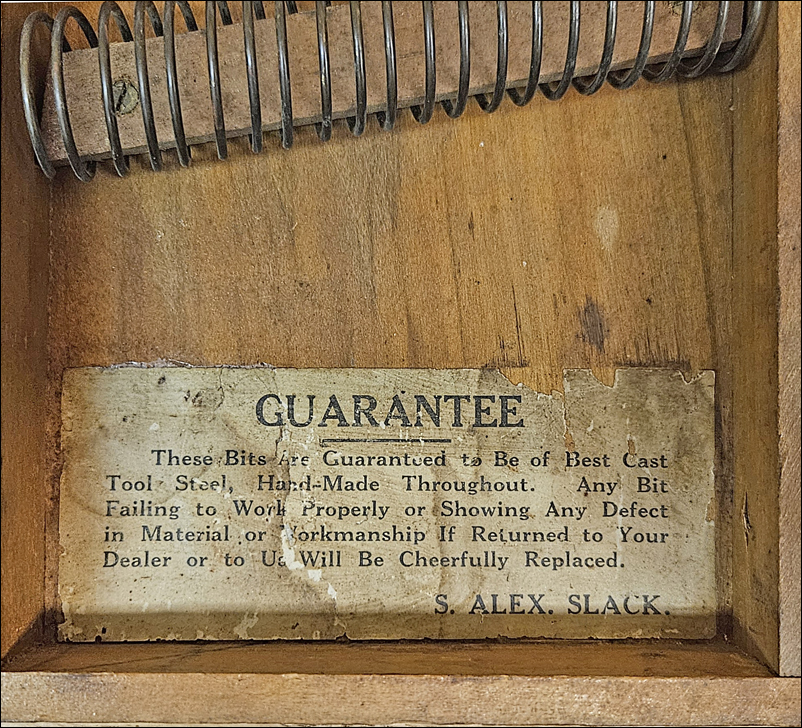
early Stickland Alex. Slack box label
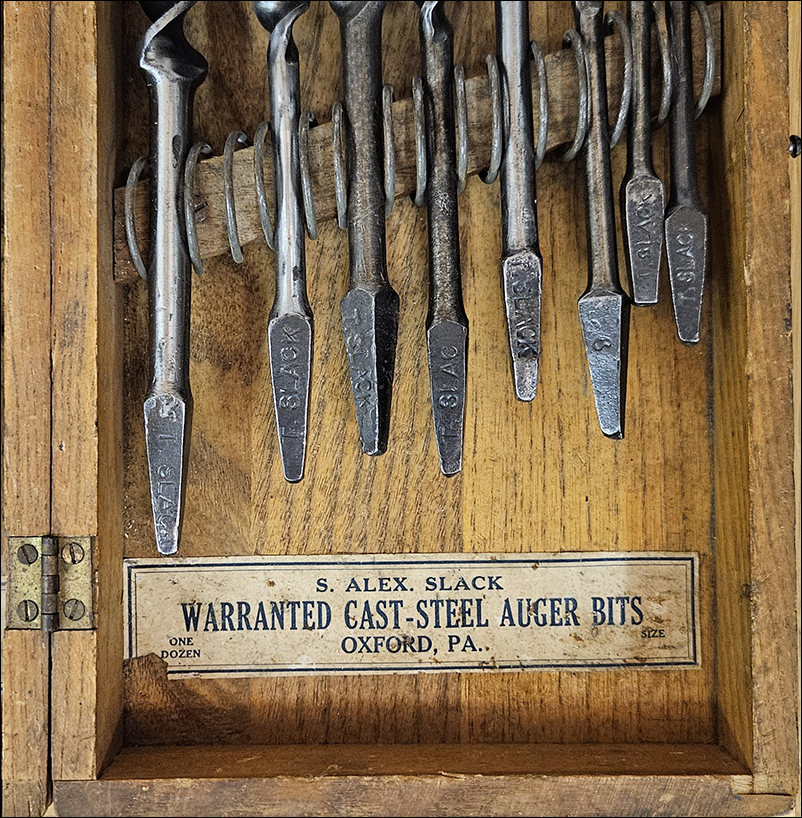
Strickland Alexander Slack
In 1908, Strickland Alexander Slack, Timothy Jr.'s nephew, who had worked for the operation as a young man, returned to the business. A master craftsman, Strickland made what might well have been the firm's smallest bit. A contemporary news article noted that it was "... an inch long and as thick as a needle and is perfect at all the points considered in the makeup of a finished bit."(11)
Slack & Son was not a long-lived business. Timothy Slack, Jr., fell ill in mid-1908 and died on December 12, 1910. A month later, Samuel Slack sold the business to Strickland A. Slack, who operated it as sole proprietor and continued to brand his augers T. Slack. Strickland Slack oversaw the shipping of "the largest auger ever made in Oxford" in 1914(12). Four and one-half inches in diameter and five and one-half feet long, it was the work of employee Paul Woodruff. S. A. Slack sold the business to the prominent Philadelphia auger manufacturer Job T. Pugh in 1925.(13) Pugh discontinued the brand.
Illustration credits:- Images of augers, stamps, and boxes: author's photos.
- Digitally enhanced map showing Slack factory: Breou's Official Series of Farm Maps, Chester County, Pennsylvania. W. H. Kirk & Co., 1883.
- Digitally edited 1904 photo of Slack factory: files of the Oxford Area Historical Association.
References:
- Thomas, George. "100 Years of Auger Making along the Elk Creeks." The Chronicle of the Early American Industries Association. v. 76, no. 2 (June 2023), p. 66-71. This article owes much to George Thomas's seminal research on the topic. See also "Maryland's Auger Makers." The Lancaster Daily Intelligencer (Lancaster, Pennsylvania). July 13, 1885. p. 2.
- "Old Concern in New location." The Oxford Press (Oxford, Pennsylvania). January 24, 1907, p. 1.
- "Auger Business Sold." The Daily Local News (West Chester, Pennsylvania). November 21, 1925, p. 4.
- [Obituary]. The Oxford Press (Oxford, Pennsylvania). January 6, 1898, p. 5.
- [Advertisement]. Public Ledger (Philadelphia, Pennsylvania). September 26, 1848, p. 3.
- Price, James. Facebook post explaining the "quarter" system used in the auger trade. Vintage Drill Use, Collecting and Restoration Group, August 21. 2026. http://www.facebook.com/groups/460427374127502/?multi_permalinks=2978461165657431.
- "Auger Factory to locate in Oxford." The Oxford Press (Oxford, Pennsylvania). September 27, 1906, p. 1.
- "A Valuable Farm of 165 Acres for Sale." The Oxford Press (Oxford, Pennsylvania). October 12, 1887, p. 3.
- "Auger Making: a Southern Chester County Industry." The Oxford Press (Oxford, Pennsylvania). April 15, 1885, p. 2.
- "Betterments of Properties." The Oxford Press (Oxford, Pennsylvania). April 14, 1904, p. 1.
- "About Town." The Oxford Press (Oxford, Pennsylvania). June 9, 1910, p. 4.
- "About Town." The Oxford Press (Oxford, Pennsylvania). March 19, 1914, p. 1.
- "About Town." The Oxford Press (Oxford, Pennsylvania). November 26, 1925, p. 1.